
Introduction
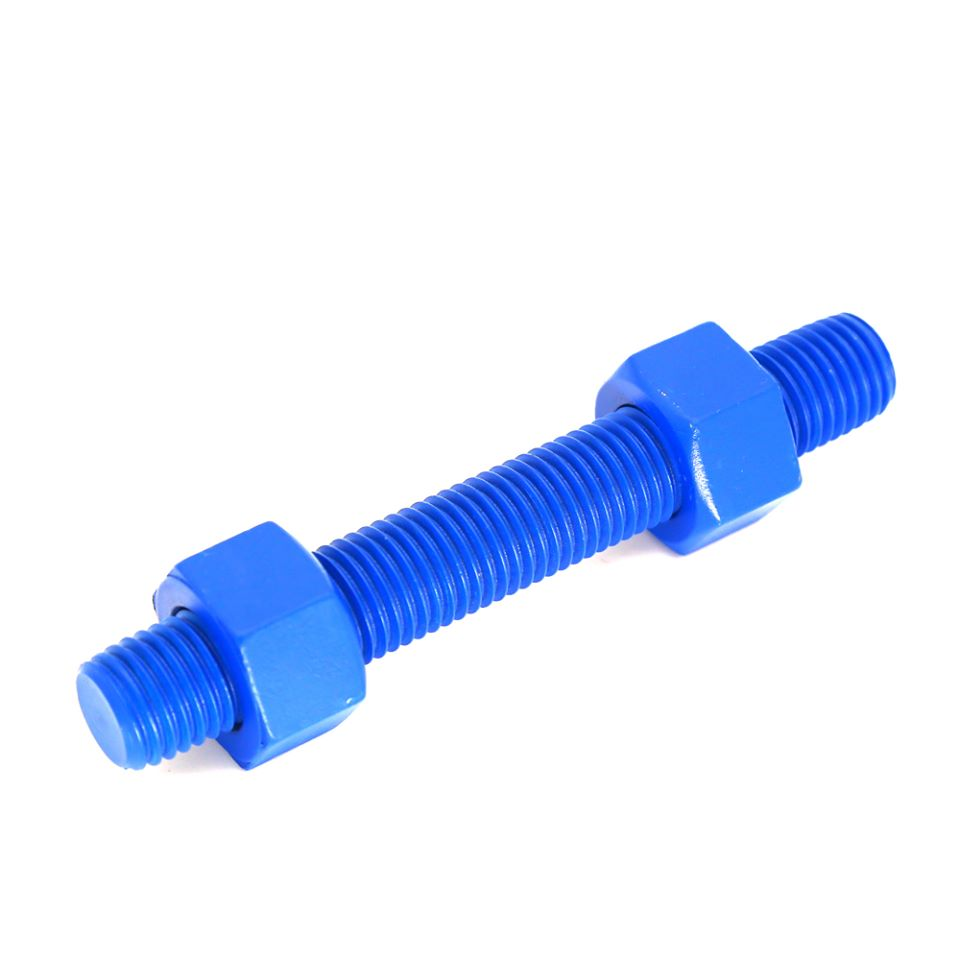
High pressure stud bolts are critical fastening elements utilized in demanding applications requiring exceptional mechanical strength and reliability under extreme conditions. These bolts are distinguished from standard bolts by their extended threaded length, designed to facilitate passage through multiple components and secure them with nuts on both ends, providing superior clamping force and resistance to loosening. They occupy a crucial technical position within the pressure vessel, pipeline, and flange connection industry chains, serving as a primary load-bearing component essential for maintaining structural integrity and preventing catastrophic failure. Core performance characteristics include tensile strength, yield strength, fatigue resistance, and resistance to stress corrosion cracking, all of which dictate their suitability for specific high-pressure, high-temperature, and corrosive environments. The increasing complexity of industrial processes and the demand for enhanced safety standards are driving the need for increasingly sophisticated high-pressure stud bolt designs and materials.
Material Science & Manufacturing
The selection of materials for high-pressure stud bolts is paramount, heavily influencing their performance and longevity. Common materials include alloy steels such as ASTM A193 Grade B7, A193 Grade B7M, A193 Grade B8, A193 Grade B8M, and A320 Grade L7. A193 B7, a chromium-molybdenum alloy steel, offers high tensile strength and is widely used in applications up to 427°C (800°F). B8 grades utilize nickel-chromium-molybdenum alloys for improved corrosion resistance and strength at elevated temperatures, extending their service life in harsh environments. A320 L7, a low-alloy steel, is favored for cryogenic applications due to its impact toughness at low temperatures. The manufacturing process typically involves cold heading to form the bolt shape, followed by heat treatment – quenching and tempering – to achieve the desired mechanical properties. Critical parameters during heat treatment include precise temperature control, holding times, and quenching medium (typically oil) to ensure uniform hardness and prevent distortion. Thread rolling, as opposed to thread cutting, is preferred as it work-hardens the surface, increasing fatigue strength. Non-destructive testing (NDT) methods like magnetic particle inspection (MPI) and ultrasonic testing (UT) are employed to detect surface and subsurface defects, ensuring compliance with stringent quality standards. Surface treatments such as zinc coating or PTFE coating are often applied to enhance corrosion resistance and reduce friction during assembly.
Performance & Engineering
The performance of high-pressure stud bolts is dictated by several key engineering principles. Force analysis, specifically tensile and shear stress calculations, is crucial for determining the appropriate bolt size and grade for a given application. Preload, the initial tension applied to the bolt during tightening, significantly impacts joint reliability and fatigue life. Insufficient preload can lead to loosening under dynamic loading, while excessive preload can cause yielding or fracture. The torque-tension relationship must be carefully calibrated to achieve the desired preload. Environmental resistance is also a critical consideration. Exposure to corrosive media (e.g., seawater, acids) can induce pitting corrosion, hydrogen embrittlement, and stress corrosion cracking, reducing the bolt's load-carrying capacity. Material selection and protective coatings play a vital role in mitigating these effects. Compliance with industry standards such as ASME Boiler and Pressure Vessel Code (Section VIII, Division 1 & 2) is mandatory in many applications. These codes specify requirements for material properties, manufacturing processes, and inspection procedures. Fatigue analysis is essential for applications subjected to cyclic loading. The S-N curve (stress vs. number of cycles to failure) is used to predict the bolt's fatigue life under specific loading conditions. Finite element analysis (FEA) is increasingly employed to simulate stress distribution within the bolt and the connected components, optimizing the joint design and ensuring structural integrity.
Technical Specifications
| Material Grade | Tensile Strength (MPa) | Yield Strength (MPa) | Hardness (Rockwell C) |
|---|---|---|---|
| ASTM A193 B7 | 690-827 | 483-620 | 30-34 |
| ASTM A193 B7M | 690-827 | 483-620 | 30-34 |
| ASTM A193 B8 | 860-1034 | 655-827 | 32-38 |
| ASTM A193 B8M | 860-1034 | 655-827 | 32-38 |
| ASTM A320 L7 | 517-655 | 310-414 | 28-32 |
| ASTM A320 L7M | 517-655 | 310-414 | 28-32 |
Failure Mode & Maintenance
High-pressure stud bolts are susceptible to several failure modes in practical applications. Fatigue cracking, induced by cyclic loading, is a common cause of failure, often initiating at stress concentration points such as thread roots. Hydrogen embrittlement, particularly in high-strength steels exposed to corrosive environments, can lead to brittle fracture. Stress corrosion cracking (SCC) occurs when tensile stress and a corrosive environment combine, resulting in crack propagation. Thread galling, caused by friction between mating threads during assembly, can lead to seizure and bolt failure. Creep, the time-dependent deformation under sustained load at elevated temperatures, can reduce preload and compromise joint integrity. Maintenance procedures should include regular visual inspections for signs of corrosion, damage, or loosening. Torque checks should be performed periodically to verify preload. Lubrication of threads during assembly is crucial to prevent galling and ensure accurate preload. In corrosive environments, protective coatings should be inspected and repaired as needed. If a bolt shows signs of damage or is suspected of being compromised, it should be replaced immediately. Detailed records of inspection and maintenance activities should be maintained for traceability and quality control. Non-destructive testing (NDT) can be employed periodically to assess the internal condition of the bolts without disassembling the joint.
Industry FAQ
Q: What is the significance of material traceability for high-pressure stud bolts?
A: Material traceability is paramount to ensuring the integrity and reliability of high-pressure stud bolts. Complete traceability, from the raw material source through each manufacturing step (heat treatment, threading, coating), allows for verification of material composition, mechanical properties, and adherence to specified standards. This is essential for investigations in the event of a failure and for demonstrating compliance with regulatory requirements. Traceability documents, such as material test reports (MTRs), should be readily available.
Q: How does thread form affect the performance of high-pressure stud bolts?
A: The thread form significantly impacts the load distribution and stress concentration within the bolt. Fine threads generally offer higher strength and are less prone to stripping, making them suitable for high-pressure applications. However, they are more susceptible to corrosion. Coarse threads are easier to assemble and less sensitive to debris, but have lower tensile strength. The thread angle and pitch also influence the bolt's performance. Unified National Fine (UNF) threads are commonly used in high-pressure applications.
Q: What are the key considerations when selecting a coating for corrosion protection?
A: The choice of coating depends on the severity of the corrosive environment. Zinc coatings provide sacrificial protection, corroding preferentially to the bolt material. PTFE coatings reduce friction and provide a barrier against corrosion. Ceramic coatings offer excellent resistance to high temperatures and corrosive media. The coating must be compatible with the bolt material and the service environment, and it must not compromise the bolt's mechanical properties or dimensional tolerances. Coating thickness and application method are also crucial factors.
Q: What is the role of controlled tightening procedures in ensuring joint integrity?
A: Controlled tightening procedures are critical for achieving the correct preload in the bolt, which is essential for joint integrity. Methods include torque control, torque-angle control, and stretch control. Torque control is the simplest method, but it is prone to inaccuracies due to friction variations. Torque-angle control provides more consistent preload by adding an angular rotation after reaching a specific torque. Stretch control is the most accurate method, directly measuring the bolt elongation to achieve the desired preload. Proper calibration of tightening equipment and adherence to specified procedures are essential.
Q: How does temperature affect the preload in a high-pressure stud bolt?
A: Temperature variations can significantly affect the preload in a high-pressure stud bolt. Thermal expansion and contraction of the bolt and connected components can alter the clamping force. As temperature increases, the bolt will expand, potentially reducing preload. Conversely, as temperature decreases, the bolt will contract, increasing preload. These changes in preload can lead to loosening or yielding. Design considerations should account for the expected temperature range and the thermal expansion coefficients of the materials involved. Periodic retightening may be necessary in applications with significant temperature fluctuations.
Conclusion
High-pressure stud bolts represent a vital component in critical industrial applications, demanding meticulous attention to material selection, manufacturing processes, and engineering principles. Their performance is intrinsically linked to a thorough understanding of mechanical properties, environmental resistance, and failure modes. Ensuring long-term reliability necessitates adhering to stringent quality control measures throughout the entire lifecycle, from initial design and fabrication to installation and ongoing maintenance.
Continued advancements in materials science and manufacturing technologies will drive further improvements in high-pressure stud bolt performance and safety. The increasing adoption of digital technologies, such as FEA and predictive maintenance tools, will enable more precise optimization of joint designs and proactive identification of potential failure mechanisms. A collaborative approach involving bolt manufacturers, end-users, and standards organizations is essential for developing and implementing best practices that ensure the integrity of critical infrastructure and processes.