
Hex Bolts vs Carriage Bolts: Selecting the Right Fastener for Your Industrial Application
In the realm of industrial fastening, the choice between hex bolts and carriage bolts is fundamental. Both are indispensable for creating strong, reliable joints in machinery, construction, and fabrication. However, their distinct designs dictate specific use cases. This product page is designed to guide B2B buyers and procurement specialists through the critical differences, helping you specify the optimal bolt for your project's demands, ensuring structural integrity, safety, and cost-efficiency.
Product Overview
Our premium-grade hex bolts and carriage bolts are engineered for high-performance applications across diverse industries. Manufactured from high-tensile steel with advanced corrosion-resistant coatings, these fasteners offer exceptional shear and tensile strength. While both serve to join materials, the hex bolts vs carriage bolts decision hinges on the need for a wrench-tightened, flush, or self-seating fastener. We provide a comprehensive range of sizes, grades, and finishes to meet exacting international standards, ensuring compatibility and reliability in every shipment.
Key Features
- Material Excellence: Manufactured from Grade 5, Grade 8, or A2/A4 stainless steel for superior strength and environmental resistance.
- Precision Threading: Uniform, clean-cut threads (UNC or UNF) ensure smooth engagement and consistent clamping force.
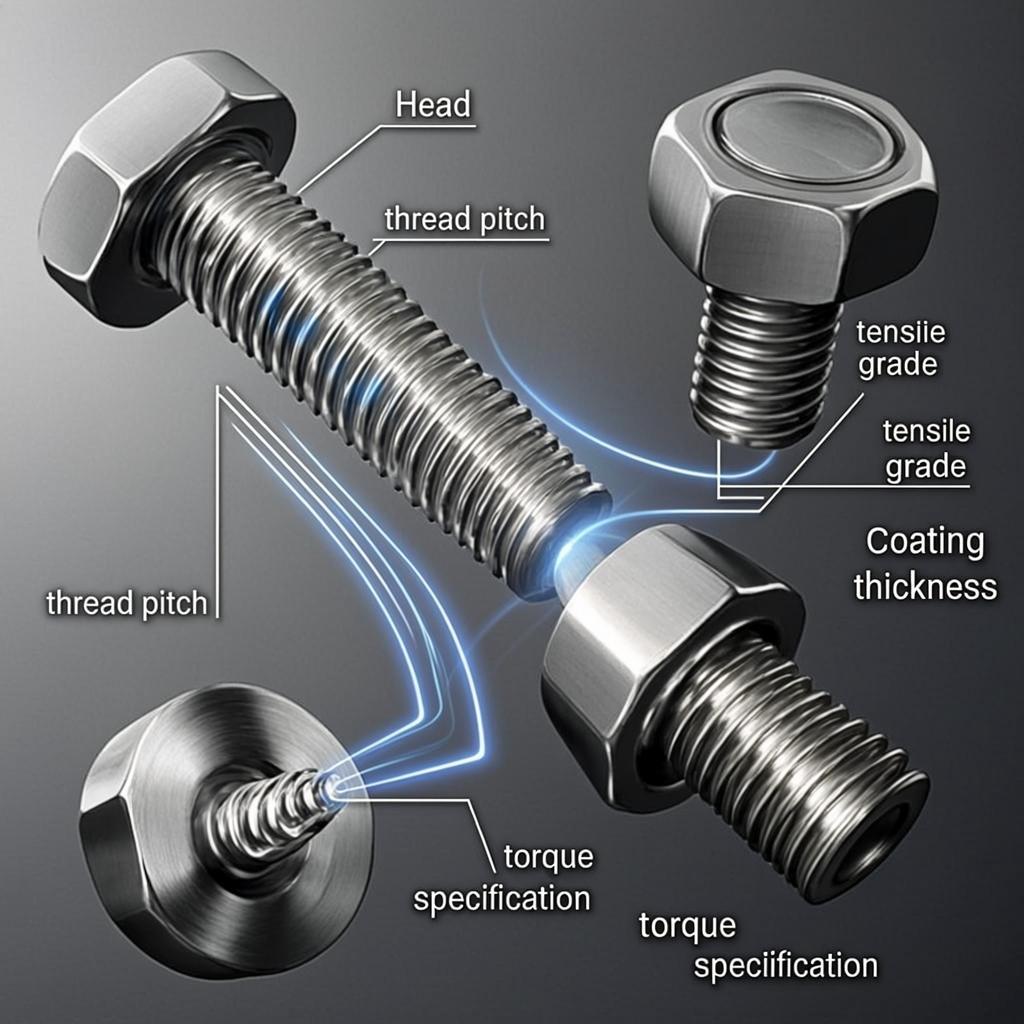
- Robust Head Design: Hex bolts feature a six-sided head for high-torque application; carriage bolts have a smooth, domed head with a square neck to prevent rotation during installation.
- Advanced Finishes: Options include hot-dip galvanizing, zinc plating, and dichromate coatings for enhanced durability against corrosion and wear.
- Quality Assurance: Every batch undergoes rigorous testing for hardness, dimensional accuracy, and load capacity, certified to ISO 898-1 and ASTM standards.
Technical Specifications
| Parameter | Hex Bolts (Heavy Hex) | Carriage Bolts |
|---|---|---|
| Head Type | Hexagonal (6-sided) | Dome-shaped with square neck |
| Primary Drive | Wrench (Socket, Spanner) | Wrench on Nut (Head is non-driving) |
| Anti-Rotation Feature | None (requires wrench on both ends) | Square neck under head locks into material |
| Ideal Joint Type | Metal-to-Metal, High-Stress | Wood-to-Wood, Wood-to-Metal |
| Common Sizes (Diameter x Length) | 1/4" to 1-1/2" x up to 24" | 1/4" to 3/4" x up to 20" |
| Typical Standards | ASTM A325, ASTM A490, ISO 4014/4017 | ASTM A307, ASME B18.5 |
Application Scenarios
Understanding the practical applications is key in the hex bolts vs carriage bolts evaluation. Hex bolts are the workhorse of structural steel, heavy machinery, and automotive assemblies where high clamping force and accessibility for a wrench are paramount. Their robust head allows for significant torque, making them ideal for flanges, brackets, and load-bearing frames.
Carriage bolts, with their self-locking square neck and smooth, low-profile head, excel in applications where a flush, snag-free finish is critical. They are the fastener of choice for wooden structures (e.g., decking, timber framing, playground equipment), securing metal channels to wood, and in conveyor systems where protruding heads could catch on materials or pose a safety hazard.
Advantages
Hex Bolts:
- High Torque Capacity: The hex head design allows for the application of substantial torque, creating extremely tight, vibration-resistant joints.
- Versatility: Suitable for a vast array of materials and pre-tapped or through holes with a nut.
- Removability & Reusability: Easily installed and removed with standard tools, facilitating maintenance and disassembly.
Carriage Bolts:
- Security & Safety: The square neck locks the bolt in place during nut tightening, preventing spin and creating a one-sided installation. The smooth head eliminates sharp edges.
- Aesthetic & Functional Finish: Provides a clean, finished look and prevents snagging in dynamic or pedestrian environments.
- Installation Efficiency: In wood applications, the square neck pulls into the material, securing itself and speeding up the assembly process.
Why Choose Us
As a leading supplier in the industrial fasteners sector, we provide more than just products; we deliver engineered solutions. Our expertise in the hex bolts vs carriage bolts landscape allows us to offer precise technical guidance, ensuring you select the correct fastener for performance, safety, and budget. We maintain an extensive in-house inventory for rapid fulfillment and offer custom manufacturing for specialized requirements. Our commitment to traceability, certified quality, and competitive global logistics makes us a reliable partner for your supply chain.
FAQ
Q: Can I use a carriage bolt in a metal-to-metal application?
A: It is not recommended for primary structural metal joints. The square neck requires a square or pre-punched hole in the metal to lock effectively, which is less common. Hex bolts are typically specified for such applications due to their superior torque and clamping performance in metal.
Q: Which is stronger, a hex bolt or a carriage bolt of the same grade?
A: The tensile and shear strength is determined by the material grade (e.g., Grade 5, Grade 8), not the head style. Therefore, a Grade 5 hex bolt and a Grade 5 carriage bolt have equivalent strength ratings. The choice between hex bolts vs carriage bolts is based on installation method and joint design, not inherent strength.
Q: Do you provide technical data sheets and certificates of conformity?
A: Yes. All our products are shipped with full material certification and traceability documentation, including Mill Test Reports (MTRs) or Certificates of Conformity (CoC) as standard, ensuring compliance with your project specifications.
Q: Can I order samples for testing and evaluation?
A: Absolutely. We encourage customers to request sample kits of our hex bolts and carriage bolts to verify dimensions, finish, and performance in your specific application before placing a bulk order.