
Modern flange bolt engineering defines the stability of high-vibration industrial structures, where mechanical connections are constantly subjected to dynamic cyclic loads.
In heavy equipment manufacturing and structural steel fabrication, joint failure rarely stems from a single sudden overload. Instead, micro-movements, fastener self-loosening, and localized fatigue stress gradually degrade joint clamping force over time. To address these vulnerabilities, engineering teams are increasingly shifting toward integrated torque-distribution solutions and high-grade metallurgical treatments.
Metallurgical Standards and Stress Distribution in Heavy Machinery
When two structural members are bolted together, the primary objective is maintaining a constant clamping force that exceeds external tension and shear forces. Standard hex bolts often rely on separate flat or lock washers to distribute load across softer mating surfaces. However, multi-piece assemblies introduce multiple friction interfaces, which can increase the likelihood of assembly errors and washer deformation under high torque.
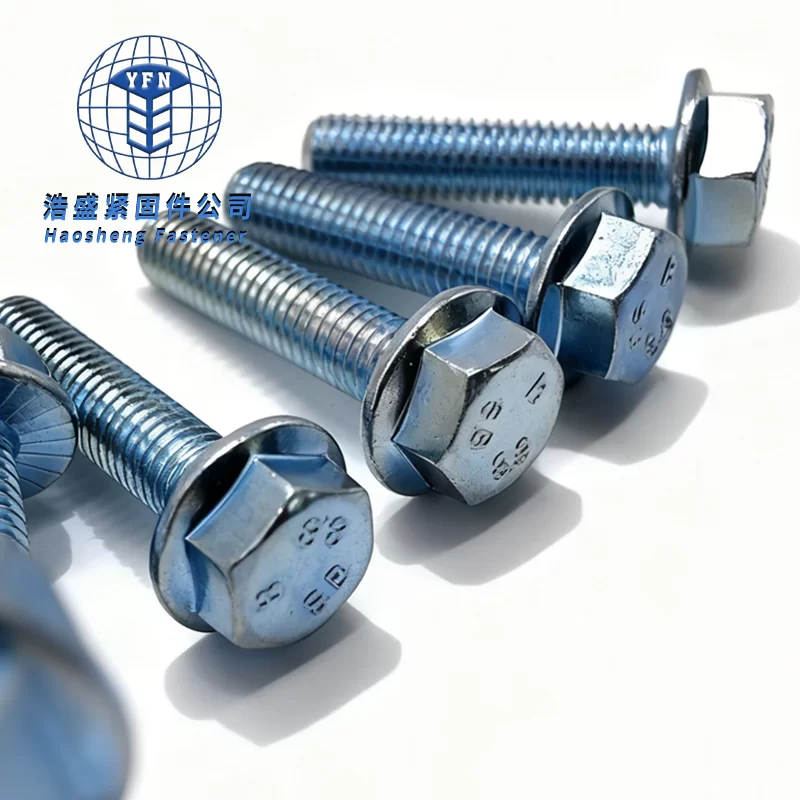
Integrated flange designs overcome this limitation by incorporating a broad circular base directly beneath the bolt head. Mathematically, expanding the bearing surface area lowers unit surface pressure, preventing localized sink-in on materials like aluminum alloys or structural carbon steels. This unified design creates a stable friction plane that resists rotational loosening under high dynamic excitation.
Mitigating Joint Fatigue with Advanced Spheroidizing Annealing
Beyond external geometry, internal grain structure dictates how fasteners tolerate continuous strain. During cold-forging, high-strength carbon and alloy steels undergo work hardening, which increases tensile strength but can induce internal shear stresses if not properly heat-treated.
Implementing precision spheroidizing annealing prior to cold-heading optimizes carbide morphology within the steel matrix. This process alters lamellar cementite into spherical particles, significantly improving ductility and cold-formability while ensuring uniform hardness distribution throughout the finished core. When paired with threaded rod specifications like din975 in tension-heavy structural frameworks, spheroidized and heat-treated components demonstrate superior toughness and elevated fatigue limits.
Supply Chain Optimization for High-Strength Fastening Systems
Ensuring joint reliability in large-scale infrastructure and industrial equipment requires absolute consistency in manufacturing tolerances. Leading industrial projects increasingly rely on automated cold-forging multi-station machinery and integrated heat treatment lines capable of producing Grade 8.8, 10.9, and 12.9 fasteners with exact thread concentricity.
Partnering with a premium manufacturer equipped with advanced testing facilities—including magnetic particle inspection, salt spray chambers, and tensile testing apparatus—allows procurement specialists to eliminate defect variance. By securing fully certified high-strength hardware from an advanced supplier, engineering managers reduce lifelong maintenance cycles, lower total cost of ownership, and guarantee structural safety across demanding global applications.